Box 3.1 Compton Scattering Transition Amplitude Derivation
Two ways (same particles in and out) for Compton scattering
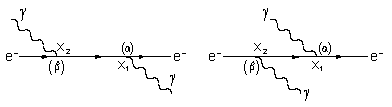 .
.
All terms in S
(n) where n ≠ 2 go to zero below since the initial state (the ket) will be acted
on by operators which will result in bras and kets which are unequal
(non-orthogonal eignenstates) and whose inner products are therefore zero. Similarly, only the term of all the n = 2 terms will result in
the same particle states in the bra and ket.
The S matrix transition amplitude for Compton scattering is thus
(with incoming particles unprimed, outgoing primed)
(B3.1-1)
(B3.1-2)
. (B3.1-3)
After the operators raise and lower the ket, only two terms in (B3.1-3) remain (i.e., have identical bra and ket). They are
Continuing with only the first term in (B3.1-4), we have (with Dirac indices explicitly shown)
. (B3.1-5)
Re-arranging factors in the above, we have
(B3.1-6)
Noting that
, (B3.1-7)
we find thus,
q = p + k = p/ + k/ (B3.1-8)
and
. (B3.1-9)
Then
where the Feynman amplitude is
Similarly, for the second term in (B3.1-4),
one gets the same relation for as (B3.1-10)
except that MB1
is replaced with
. (B3.1-12)
Thus,
(B3.1-13)
Return to Unifying Chart 3 Part 2.